Household Aluminum Foil vs Industrial Aluminum Foil
Aluminum foil is one of the most versatile materials in the world. Whether you are wrapping a sandwich in your kitchen or insulating a massive skyscraper, aluminum foil plays a critical role. However, there is a major difference between household aluminum foil vs industrial aluminum foil.
While they might look similar, their chemical composition, thickness ($$t$$), strength, and production standards are very different. In this guide, we will compare household aluminum foil vs industrial aluminum foil to help you understand which type is right for your specific needs.
Quick Overview: Household vs Industrial Foil
Before we dive into the technical details, let’s look at a high-level comparison.
Table 1: At-a-Glance Comparison
| Feature | Household Aluminum Foil | Industrial Aluminum Foil |
|---|---|---|
| Main Use | Food storage, cooking, baking | Insulation, electronics, packaging |
| Common Alloy | $$8011$$ | $$1235$$, $$1050$$, $$1060$$, $$8011$$ |
| Typical Thickness ($$t$$) | $$8 \text{ microns}$$ to $$25 \text{ microns}$$ | $$6 \text{ microns}$$ to $$200 \text{ microns}$$ |
| Temper | Soft ($$O$$) | Soft ($$O$$), Hard ($$H18$$), Semi-hard |
| Width ($$W$$) | $$200 \text{ mm}$$ to $$600 \text{ mm}$$ | Up to $$1600 \text{ mm}$$ or more |
| Surface Finish | One side bright, one side matte | Mill finish, bright, or coated |
What is Household Aluminum Foil?
Household aluminum foil is the consumer-grade product found in supermarkets. It is primarily used for food preservation and cooking. Because it comes into direct contact with food, it must meet strict “Food Grade” safety standards.
Key Characteristics of Household Foil:
- Flexibility: It is very soft ($$O$$ temper), allowing it to wrap easily around bowls or leftovers.
- Safety: It is non-toxic, odorless, and moisture-proof.
- Dead-fold Property: Once folded, it stays in place without springing back.
Table 2: Common Specifications for Household Foil
| Property | Standard Value |
|---|---|
| Alloy Type | $$8011$$ |
| Thickness ($$t$$) | $$0.008 \text{ mm} – 0.025 \text{ mm}$$ |
| Width ($$W$$) | $$300 \text{ mm}, 450 \text{ mm}$$ (Standard) |
| Length per Roll | $$3 \text{ m}$$ to $$300 \text{ m}$$ |
| Inner Core Diameter | $$32 \text{ mm}, 38 \text{ mm}, 76 \text{ mm}$$ |
Common Applications of Household Aluminum Foil
- Food Wrapping: Keeping sandwiches and leftovers fresh.
- Baking and Roasting: Lining pans to prevent sticking and catching drips.
- Grilling: Wrapping potatoes or fish to steam them on the BBQ.
- Heat Protection: Covering the crust of a pie to prevent it from burning.
- Storage: Preventing freezer burn in the refrigerator.
What is Industrial Aluminum Foil?
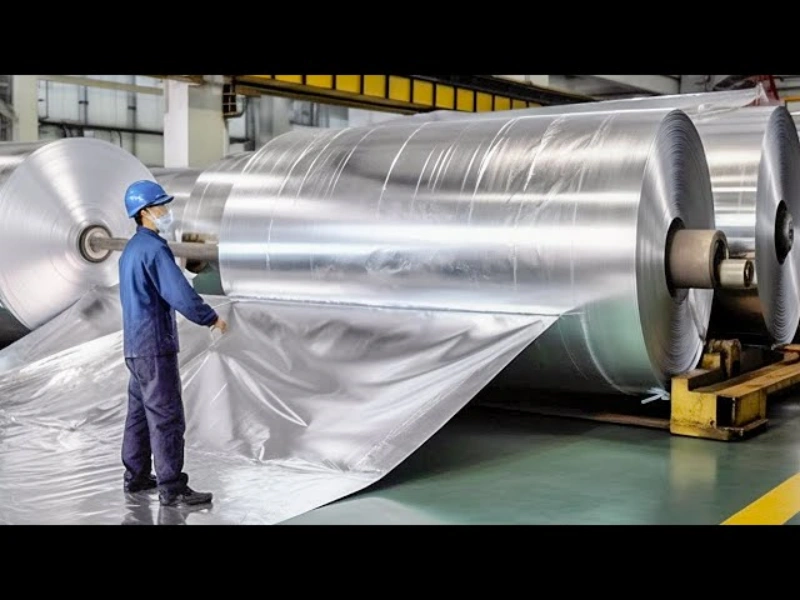
Industrial aluminum foil is a heavy-duty material used in manufacturing. It is often a component of a larger product, such as a battery, a transformer, or a building’s insulation system. When comparing household aluminum foil vs industrial aluminum foil, the industrial version is much more diverse in its technical specifications.
Key Characteristics of Industrial Foil:
- High Purity: Often requires $$99%$$ or higher aluminum content (Series $$1000$$).
- Tensile Strength: Can be manufactured in hard tempers ($$H18$$) for high-speed machines.
- Pinhole Control: Industrial foils for pharmaceutical or electronic use must have near-zero pinholes ($$p = 0$$).
Table 3: Technical Specifications for Industrial Foil Grades
| Alloy Grade | Key Feature | Primary Industrial Use |
|---|---|---|
| Alloy 1235 | High $$Al$$ content ($$99.35%$$) | Flexible packaging, Cigarette foil |
| Alloy 1060/1070 | Excellent conductivity | Capacitors, Lithium batteries |
| Alloy 8011 | High strength | Pharmaceutical blisters, Bottle caps |
| Alloy 8079 | Better elongation | High-end aseptic packaging |
| Alloy 3003 | Corrosion resistance | Honeycomb cores, Heat exchangers |
Major Applications of Industrial Aluminum Foil
The applications of industrial aluminum foil span across multiple billion-dollar industries.
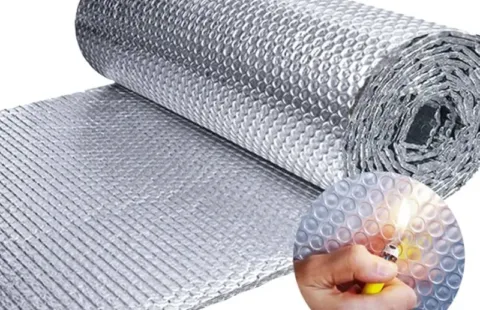
- Building Insulation: Laminated with glass wool or foam for radiant heat barriers.
- Electronics: Used as a shield for cables and a collector in battery cells.
- Pharmaceutical Packaging: The “push-through” foil on medicine blister packs.
- HVAC Systems: Fins for air conditioners and heat exchangers.
- Automotive: Heat shields and engine components.
- Cigarette Packaging: Lining inside cigarette boxes to maintain moisture.
Thickness Comparison: Household vs Industrial
Thickness ($$t$$) is perhaps the most significant differentiator when discussing household aluminum foil vs industrial aluminum foil.
Table 4: Thickness ($$t$$) Range Comparison
| Category | Thickness in Microns ($$\mu\text{m}$$) | Thickness in Millimeters ($$mm$$) |
|---|---|---|
| Thin Industrial Foil | $$6 \mu\text{m} – 9 \mu\text{m}$$ | $$0.006 – 0.009 \text{ mm}$$ |
| Standard Household Foil | $$10 \mu\text{m} – 18 \mu\text{m}$$ | $$0.010 – 0.018 \text{ mm}$$ |
| Heavy Duty Household | $$20 \mu\text{m} – 25 \mu\text{m}$$ | $$0.020 – 0.025 \text{ mm}$$ |
| Container Foil | $$40 \mu\text{m} – 80 \mu\text{m}$$ | $$0.040 – 0.080 \text{ mm}$$ |
| Industrial Duct Foil | $$50 \mu\text{m} – 150 \mu\text{m}$$ | $$0.050 – 0.150 \text{ mm}$$ |
Mechanical Properties: Strength and Elongation
In industrial settings, the foil must survive high-speed tension. Household foil only needs to survive being pulled out of a box.
Table 5: Typical Mechanical Properties
| Foil Type | Tensile Strength ($$MPa$$) | Elongation ($$%$$) |
|---|---|---|
| Household (8011-O) | $$60 – 110$$ | $$\ge 15%$$ |
| Battery Foil (1060-H18) | $$\ge 160$$ | $$\ge 1.5%$$ |
| Packaging Foil (1235-O) | $$60 – 100$$ | $$\ge 2.0%$$ |
| Finstock (3003-H24) | $$120 – 160$$ | $$\ge 10%$$ |
Production Standards and Quality Control
When comparing household aluminum foil vs industrial aluminum foil, the testing methods differ based on the end-use.
Table 6: Quality Control Tests
| Test Type | Household Foil Focus | Industrial Foil Focus |
|---|---|---|
| Chemical Analysis | Food safety & heavy metal limits | Purity levels ($$99.9%+$$) |
| Wettability | Not usually required | Grade $$A$$, $$B$$, or $$C$$ (Oil residue) |
| Pinhole Test | Visual check | Light box or electronic count |
| Surface Finish | Brightness and uniformity | Surface tension and coating adhesion |
| Rolling Oil | Food-grade lubricant | Industrial lubricant (must be removed) |
The Role of Alloys in Foil Manufacturing
The choice of alloy ($$A$$) determines the performance of the foil. Most household aluminum foils use alloy $$8011$$, but industrial foils vary widely.
Table 7: Alloy Composition Breakdown (Approximate)
| Alloy | $$Si + Fe$$ (%) | $$Cu$$ (%) | $$Mn$$ (%) | $$Mg$$ (%) | $$Al$$ (%) |
|---|---|---|---|---|---|
| 1235 | $$0.65$$ | $$0.05$$ | $$0.05$$ | $$0.05$$ | $$99.35 \min$$ |
| 1060 | $$0.25$$ | $$0.05$$ | $$0.03$$ | $$0.03$$ | $$99.60 \min$$ |
| 8011 | $$1.4 – 2.0$$ | $$0.10$$ | $$0.20$$ | $$0.05$$ | Balance |
| 3003 | $$0.6$$ | $$0.05 – 0.20$$ | $$1.0 – 1.5$$ | — | Balance |
Packaging and Delivery Specs
Because industrial customers buy in bulk, the “packaging” of the foil roll itself is a major part of the industrial aluminum foil specifications.
Table 8: Roll Dimensions and Shipping
| Specification | Household Retail Roll | Industrial Jumbo Roll |
|---|---|---|
| Weight per Roll | $$200 \text{ g} – 2 \text{ kg}$$ | $$100 \text{ kg} – 1000 \text{ kg}$$ |
| Outer Diameter ($$OD$$) | $$40 \text{ mm} – 60 \text{ mm}$$ | $$300 \text{ mm} – 1000 \text{ mm}$$ |
| Core Material | Paperboard | Steel, Aluminum, or Thick Paper |
| Packing Method | Individual color box | Fumigated wooden crates |
Sustainability and Recycling
Both household aluminum foil vs industrial aluminum foil are highly sustainable. Aluminum is $$100%$$ recyclable without any loss in quality.
- Household Recycling: Used foil should be cleaned of food residue before being tossed into the recycling bin.
- Industrial Recycling: Factories often have “closed-loop” systems where scrap foil from production is melted down immediately to make new rolls.
- Energy Savings: Recycling aluminum uses only $$5%$$ of the energy required to produce primary aluminum from bauxite ore.
Key Differences in Price and Sourcing
If you are a business owner, the price per kilogram ($$kg$$) will vary based on whether you are buying finished consumer goods or raw materials.
- Industrial Pricing: Usually based on the “LME (London Metal Exchange) Price + Fabrication Fee.”
- Household Pricing: Includes the cost of the color box, the plastic cutter, the retail brand’s marketing, and logistics.
- Minimum Order Quantities (MOQ): Industrial suppliers usually require orders of $$2$$ to $$5$$ tons ($$MT$$).
Frequently Asked Questions (FAQ)
Q1: Can I use industrial foil for cooking?
It depends on the alloy and lubricants. Pure industrial foil like $$1235-O$$ is technically safe, but industrial-grade lubricants might not be food-safe. It is always safer to use household aluminum foil for food.
Q2: Why is household foil shiny on one side and dull on the other?
This is a result of the “doubling” process during rolling. The sides touching the steel rollers become shiny, while the sides touching each other become matte.
Q3: What is the “micrometer” ($$\mu\text{m}$$) of standard kitchen foil?
Most standard household rolls are around $$10 \mu\text{m}$$ to $$12 \mu\text{m}$$. “Heavy duty” rolls are usually $$18 \mu\text{m}$$ to $$24 \mu\text{m}$$.
Q4: Which alloy is best for battery manufacturing?
Typically, Alloy 1060 or 1070 is used because of the high electrical conductivity required for the battery cathode.
Which One Do You Need?
Understanding the differences between household aluminum foil vs industrial aluminum foil is vital for making the right purchase.
- Choose Household Aluminum Foil if you are in the retail, catering, or food service business. Look for alloy $$8011-O$$ with food-grade certification.
- Choose Industrial Aluminum Foil if you are a manufacturer in the insulation, electronics, or flexible packaging sector. You will need to specify the exact alloy, temper, and thickness required for your machinery.
Both types of foil offer the incredible benefits of being light, strong, and recyclable. By selecting the correct technical specifications, you can ensure the best performance for your project or product.
For more information on specific jumbo rolls or industrial foil grades, please contact our technical sales team for a detailed quote.
Leave a Comment
You must be logged in to post a comment.