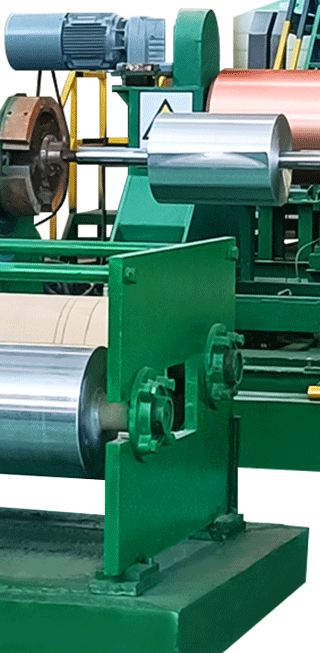
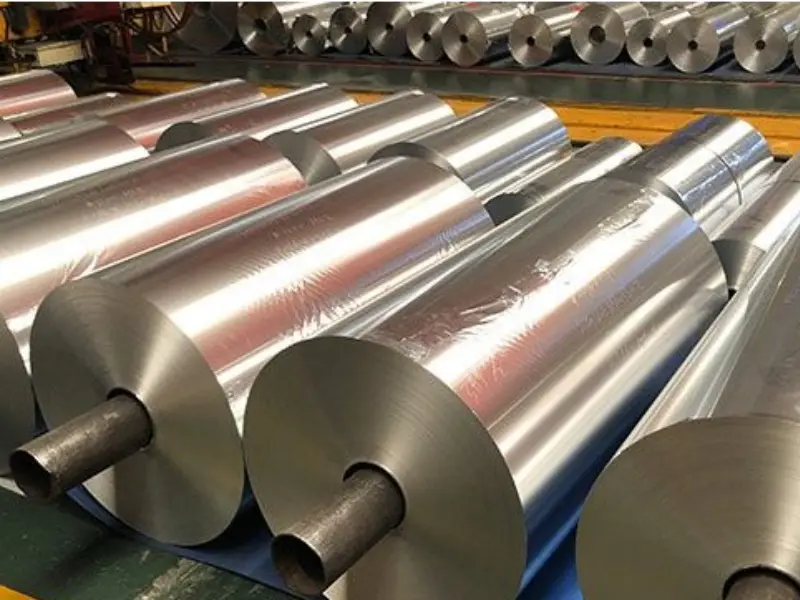
Aluminum Foil Supplier China market. Factories here produce millions of tons each year.
Buyers from every continent source rolls, sheets, and specialty foils from Chinese suppliers.
What Makes Chinese Foil Competitive
Labor costs stay lower than in Europe or North America. Raw bauxite is abundant. Modern rolling mills run at high speed. These factors keep prices attractive without sacrificing quality. Many plants hold ISO 9001, FDA, and SGS certificates. Export volumes grow year after year.
Alloy Families We Work With
Aluminum foil is not one single metal. Different alloys change strength, corrosion resistance, and formability.
1xxx Series: Pure Aluminum
| Alloy | Aluminum Content | Typical Use |
|---|---|---|
| 1050 | 99.5% | General wrapping, cable shielding |
| 1060 | 99.6% | Transformer winding, chemical equipment |
| 1100 | 99.0% | Fin stock, light-duty packaging |
| 1145 | 99.45% | Capacitor electrodes, insulation |
| 1235 | 99.35% | Flexible packaging, lithium battery foil |
This group bends easily. It resists corrosion well. Pure grades conduct heat and electricity better than alloyed grades.
3xxx Series Aluminum Foil Supplier China: Manganese Alloys
| Alloy | Key Feature | Common Application |
|---|---|---|
| 3003 | Moderate strength | Heat exchanger fins, cooking pans |
| 3004 | Higher strength | Food containers, bottle caps |
| 3102 | Good formability | Air-conditioner components |
Manganese adds strength. These alloys handle higher temperatures than pure aluminum.
5xxx Series: Magnesium Alloys Aluminum Foil Supplier China
| Alloy | Characteristic | Where It Goes |
|---|---|---|
| 5052 | Excellent salt-water resistance | Marine parts, chemical tanks |
| 5056 | Extra toughness | Rivets, zipper foil |
Magnesium makes the metal harder. You see 5xxx grades in harsh environments.
8xxx Series Aluminum Foil Supplier China: Iron and Silicon Additions
| Alloy | Silicon % | Iron % | Primary Market |
|---|---|---|---|
| 8011 | 0.50–0.90 | 0.60–1.00 | Household foil, bottle caps |
| 8021 | 0.05–0.15 | 0.40–0.80 | Pharmaceutical blister packs |
| 8079 | 0.05–0.30 | 0.70–1.30 | Flexible laminate, snack bags |
| 8006 | 0.30–0.60 | 1.20–2.00 | Rigid containers, oven trays |
These are the workhorses of the foil world. 8011 alone accounts for a huge share of global household roll production.
Temper Codes Explained
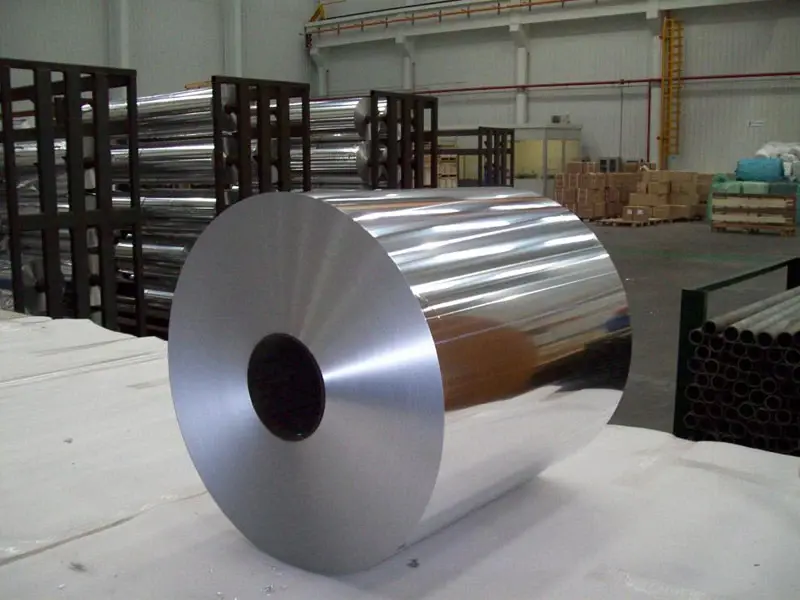
Temper tells you how hard or soft the foil is. It also reveals how much the metal was worked after the final anneal.
| Temper | Description | Feel | Best For |
|---|---|---|---|
| O (Soft) | Fully annealed | Very pliable | Wrapping food, deep drawing |
| H14 | Strain-hardened, quarter hard | Slightly stiff | Medium-duty packaging |
| H18 | Strain-hardened, full hard | Rigid, springy | Rigid containers, fins |
| H22 | Partially annealed after hardening | Soft with some strength | Lidding, semi-rigid trays |
| H24 | Similar to H22, slightly harder | Firm but formable | Bottle caps, shallow draws |
Soft temper (O) is what you feel in kitchen rolls. Hard temper (H18) holds shape in baking pans.
Thickness Breakdown
Foil thickness is measured in microns (μm) or millimeters (mm). Some buyers still use gauge, but metric is standard in China.
| Category | Thickness Range | Micron Equivalent | Typical Products |
|---|---|---|---|
| Ultra-light | 0.006–0.009 mm | 6–9 μm | Chocolate wrapping, capacitor film |
| Light | 0.010–0.019 mm | 10–19 μm | Household rolls, flexible pouches |
| Standard | 0.020–0.039 mm | 20–39 μm | Container lids, insulation layers |
| Heavy | 0.040–0.099 mm | 40–99 μm | Deep trays, industrial gaskets |
| Extra-heavy | 0.100–0.200 mm | 100–200 μm | Rigid pans, structural honeycomb |
Anything below 0.2 mm is generally called foil. Above that, the industry shifts to “aluminum sheet.”
Product Lines in Detail
Household Aluminum Foil Rolls
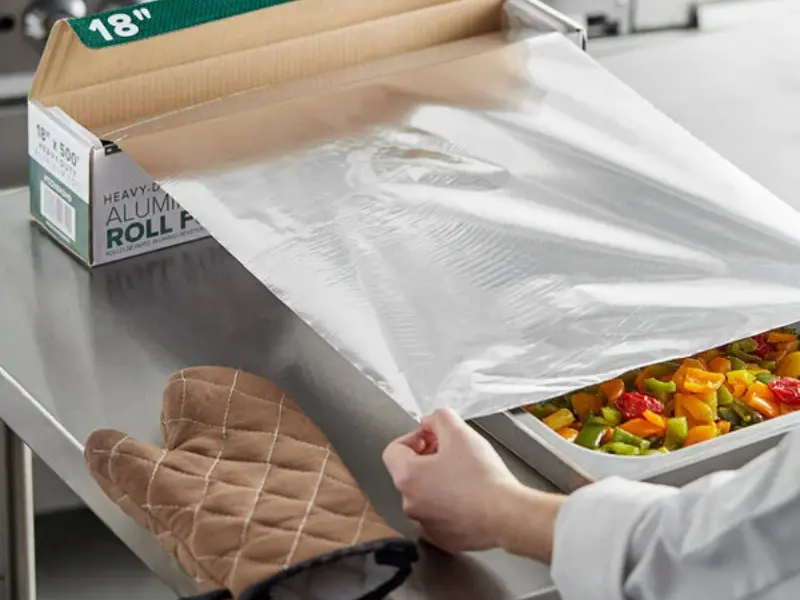
These are the silver rolls in every kitchen. Widths range from 250 mm to 450 mm. Lengths vary from 5 meters to 300 meters. Core diameters are usually 25 mm or 30 mm. Alloy 8011-O dominates this segment. Some premium brands use 1235-O for extra purity.
Aluminum Foil Containers
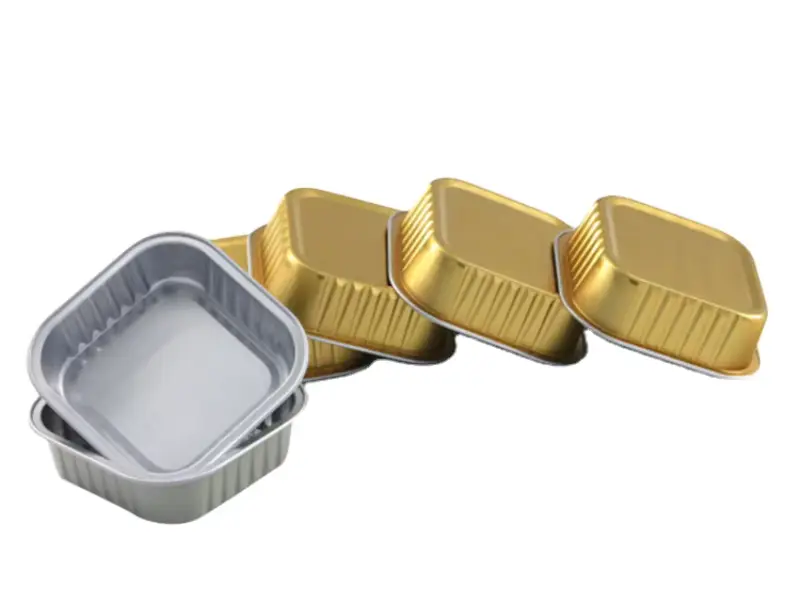
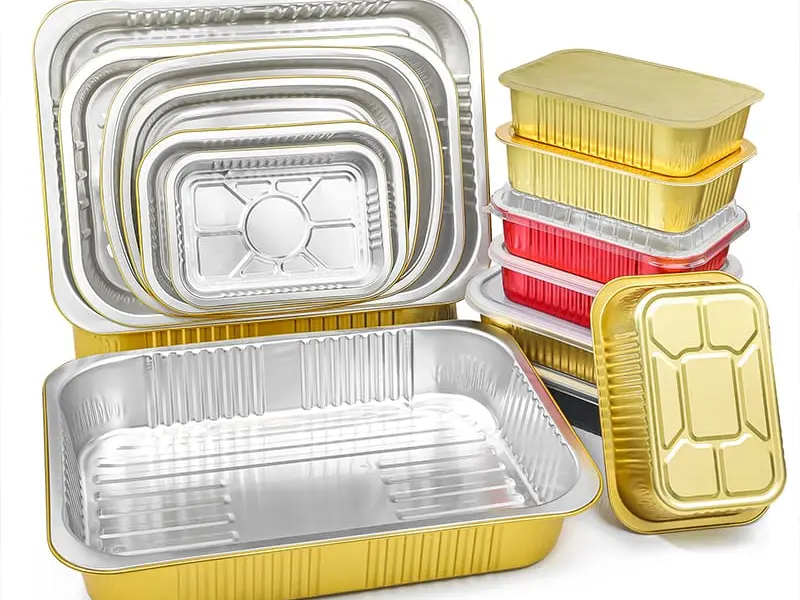
Takeaway boxes, airline trays, and bakery molds fall here. They are stamped from heavier gauges. Common shapes include:
- Rectangular trays (no. 1 through no. 9 sizes)
- Round pie pans (diameter 80 mm to 280 mm)
- Oblong roasting pans
- Divided compartment plates
- Lid covers with crimp edges
Alloys: 8011-H24, 3003-H24, 8006-H22. Thickness: 0.03 mm to 0.08 mm.
Pharmaceutical Blister Foil
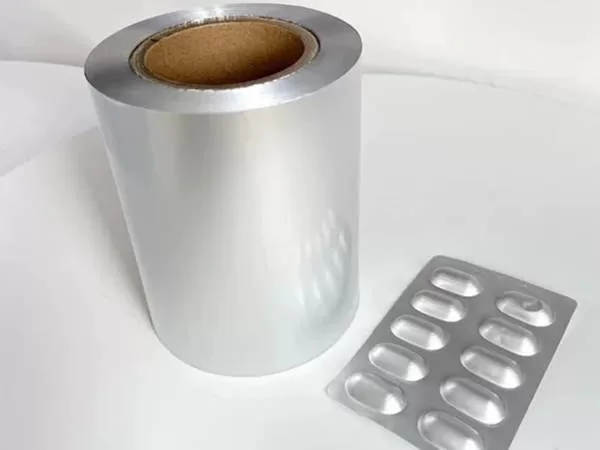
Pills need protection from moisture and oxygen. Blister packs use cold-form foil or push-through lidding. Cold-form grades are soft (O temper) and laminated with PVC. Push-through lidding is hard (H18) and coated with heat-seal lacquer.
| Property | Cold-Form Foil | Push-Through Lid |
|---|---|---|
| Alloy | 8021-O | 8011-H18 |
| Thickness | 0.045–0.060 mm | 0.020–0.025 mm |
| Structure | Multi-layer laminate | Single layer + coating |
| Barrier | Near-perfect | Good |
| Child resistance | Excellent | Moderate |
Snack bags, coffee pouches, and retort pouches use thin foil laminated to plastic films. Alloy 1235 and 8079 are favorites. Thickness is usually 6–12 microns. The foil blocks light, oxygen, and odors.
Flexible Packaging Foil
Industrial Aluminum Foil
Factories use foil for insulation, sealing, and shielding. This category includes:
- HVAC duct wrap (with fiberglass backing)
- Pipe insulation jackets
- Cable shielding tapes
- EMI/RFI shielding laminates
- Cryogenic super-insulation layers
Alloys vary. 1060 and 1145 are common for electrical uses. 3003 appears in thermal applications.
Honeycomb Core Foil
Aerospace panels and building partitions use aluminum honeycomb. Thin foil strips are bonded into hexagonal cells. Alloy 5052-H18 is standard. Thickness is 0.04–0.08 mm. Cell sizes range from 3 mm to 25 mm.
Battery Foil
Lithium-ion cells need current collectors. Cathode foil is typically 1235 or 1060, 10–20 microns thick. Some plants now produce 8-micron foil for high-density cells. Surface treatment improves adhesion to active materials.
Cigarette and Tobacco Foil
Inner liners keep tobacco fresh. Alloy 1235-O, 6–7 microns, is the norm. Some brands specify 1145 for its extra purity. The foil is printed and laminated to paper.
Side-by-Side Alloy Comparison
Buyers often ask which alloy fits their job. Here is a quick reference.
| Factor | 8011 | 1235 | 3003 | 8021 |
|---|---|---|---|---|
| Cost | Low | Medium | Medium | Higher |
| Strength | Good | Low | Better | Good |
| Corrosion resistance | Good | Excellent | Better | Excellent |
| Deep draw ability | Very good | Excellent | Moderate | Very good |
| Typical temper | O, H14, H18, H22, H24 | O, H18 | O, H14, H24 | O, H18 |
| Main market | Household, containers | Packaging, capacitors | Heat exchangers, pans | Pharma, high-barrier |
Aluminum Foil Supplier China Thickness vs. Application Map
Not sure which gauge to pick? Use this table.
| Application | Recommended Thickness | Recommended Alloy |
|---|---|---|
| Chocolate wrapping | 6–9 μm | 1235, 8079 |
| Kitchen foil (home use) | 10–14 μm | 8011-O |
| Heavy-duty kitchen foil | 18–25 μm | 8011-O |
| Takeaway container | 35–60 μm | 8011-H24, 3003-H24 |
| Oven-ready tray | 60–100 μm | 8006-H22, 8011-H24 |
| Blister pack (cold form) | 45–60 μm | 8021-O |
| Blister pack lid | 20–25 μm | 8011-H18 |
| Air duct insulation | 20–30 μm | 1060, 1145 |
| Cable wrap | 50–100 μm | 1145, 1060 |
| Honeycomb core | 40–80 μm | 5052-H18 |
| Battery current collector | 10–20 μm | 1235, 1060 |
Key Industries We Serve Aluminum Foil Supplier China
Aluminum foil touches almost every sector. Here are the main ones.
Printing: Labels, holographic stamping, gift wrap lamination
Food and Beverage: Wrapping sandwiches, lining pans, sealing yogurt cups, covering restaurant trays
Pharmaceuticals: Blister packs, strip packs, sachets, transdermal patches
Cosmetics: Single-use sample packets, tube laminates, jar seals
Electronics: Capacitor electrodes, cable shields, battery current collectors, heat sinks
Construction: Roof insulation, vapor barriers, radiant floor heating reflectors
Automotive: Heat shields, air-conditioner fins, sound dampening layers
Aerospace: Honeycomb panels, thermal insulation blankets, fuel tank liners
Energy: Solar panel backsheets, LNG tank insulation, transformer winding
Tobacco: Cigarette inner liners, cigar tubes, chewing tobacco pouches
Surface Finishes and Treatments
Aluminum Foil Supplier China is not always shiny silver. Suppliers offer several surface options.
| Finish | Description | Use Case |
|---|---|---|
| Bright mill finish | Highly reflective, smooth | Decorative, insulation |
| Matte finish | Dull, low glare | Printing, labels |
| Embossed | Textured patterns | Anti-slip trays, decorative wrap |
| Pre-lubricated | Thin oil layer | Deep drawing, stamping |
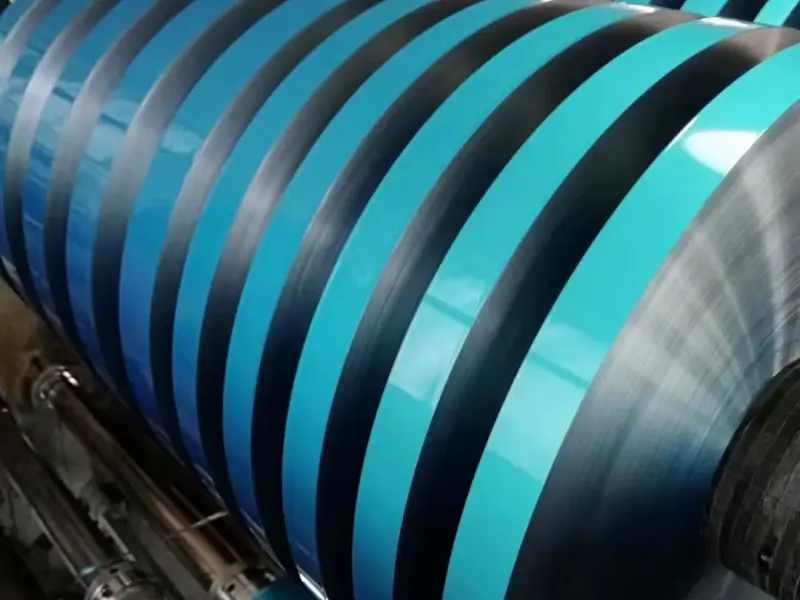
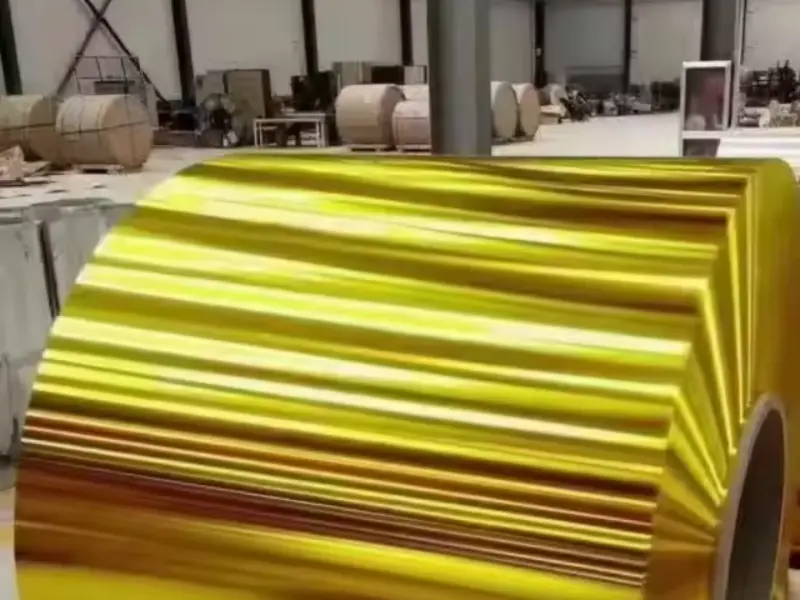
| Color-coated | Painted or lacquered | Bottle caps, decorative foil |
| Printed | Custom logos and designs | Food service, retail packaging |
Width and Coil Specifications
Chinese mills produce coils in many sizes. Standard widths include:
- 200 mm, 250 mm, 300 mm, 400 mm, 450 mm, 500 mm
- 600 mm, 800 mm, 1000 mm, 1200 mm, 1500 mm
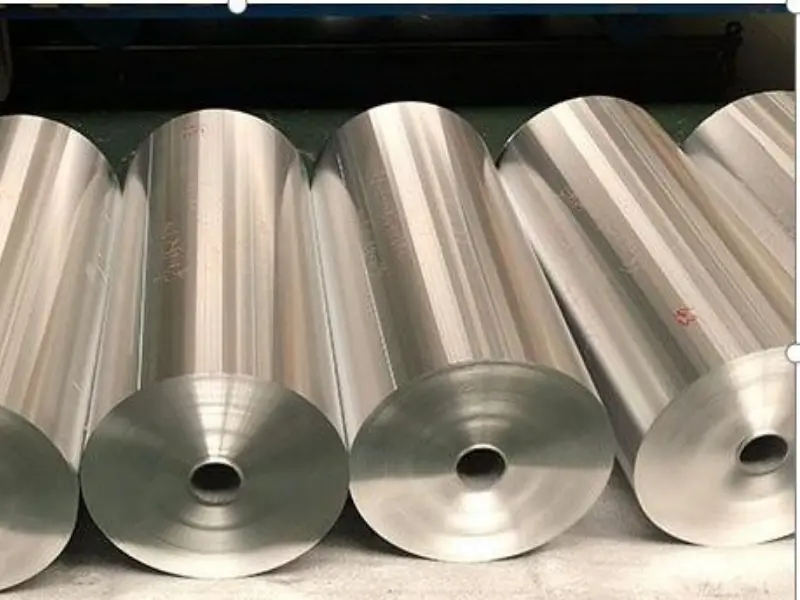
Jumbo rolls can exceed 1600 mm in width. These are slit down to smaller rolls at finishing lines. Core sizes are 76 mm (3 inch) or 152 mm (6 inch) for industrial coils. Household rolls use cardboard cores of 25–38 mm.
Maximum coil weight depends on the mill. Common ranges are 500 kg to 8000 kg per coil. Some large mills handle up to 15 metric tons.
Aluminum Foil Supplier China Quality Checks Before Shipment
Reliable suppliers run multiple tests. Buyers should ask for these reports.
- Thickness gauge: Laser or micrometer scan across the full width
- Tensile test: Measures strength and elongation
- Erichsen cupping: Tests deep-draw capability
- Pinhole count: Counts light leaks per square meter
- Surface inspection: Camera systems detect scratches and stains
- Chemical analysis: Confirms alloy composition
- Oil residue test: Ensures clean surface for lamination
- Wettability test: Checks surface energy for coating adhesion
Packaging and Shipping Details
Foil is delicate. Proper packing prevents edge damage and moisture.
| Shipping Form | Protection Method | Container Load |
|---|---|---|
| Jumbo coils | VCI paper + steel strapping | Flat rack or open top |
| Slit coils | Foam pads + wooden pallets | 20 GP or 40 GP |
| Household rolls | Shrink film + color boxes | 40 HQ |
| Cut sheets | Interleaved paper + wooden cases | 40 HQ |
| Container lids | Stack nested + carton boxes | 40 HQ |
Sea freight is standard for bulk orders. Air freight works for urgent samples. Lead times range from 15 to 45 days depending on quantity and alloy.
Customization Services
Most Chinese suppliers accept custom orders. Options include:
- Slitting to exact width
- Cutting to sheet size
- Printing up to eight colors
- Embossing custom patterns
- Applying heat-seal coatings
- Laminating to paper, PE, or PET film
- Annealing to specific temper
- Edge trimming or deburring
Minimum order quantities vary. Jumbo coils may start at 3–5 tons. Printed household rolls might need 10,000 boxes. Always confirm MOQ before sampling.
How to Choose the Right Supplier
Not every factory fits every buyer. Consider these points.
- Experience: How many years in foil production?
- Equipment: Does the mill have modern cold rolling mills?
- Certifications: ISO, FDA, SGS, REACH, RoHS?
- Export history: Do they ship to your country regularly?
- Sample policy: Will they send free samples for testing?
- Payment terms: T/T, L/C, or D/P?
- After-sales support: How do they handle quality claims?
Visit the factory if possible. Video audits are a good second choice.
Frequently Asked Questions
What is the most common alloy for household foil?
Alloy 8011 dominates. It balances cost, softness, and tear resistance. Some premium brands use 1235 for higher purity.
Which temper should I pick for deep-drawn containers?
Choose O temper (soft annealed). It stretches without tearing. H22 is acceptable for shallow draws.
Can I order foil thinner than 6 microns?
Yes, but only from specialized mills. Capacitor foil can reach 4–5 microns. Battery foil is now produced at 8 microns. Thinner foil costs more and has higher pinhole risk.
Is Chinese aluminum foil food-safe?
Reputable mills use food-grade alloys and annealing processes. Look for FDA, EU 10/2011, or GB 4806 compliance certificates. Always verify with lab tests if unsure.
What is the difference between 8011 and 8079?
Both are 8xxx series. 8079 has slightly different iron and silicon levels. It offers better barrier properties in thin gauges. Flexible packaging makers prefer 8079. Household product makers prefer 8011.
How do I prevent foil from cracking during stamping?
Use soft temper (O). Keep the foil warm. Apply proper lubrication. Check die clearance. Choose an alloy with good elongation, such as 8011 or 3003.
Can foil be recycled?
Yes. Aluminum recycles indefinitely. Clean household foil goes into standard recycling streams. Laminated or heavily soiled foil may need special handling.
What surface treatments improve printing adhesion?
Corona treatment or chemical priming raises surface energy. Matte finishes also accept ink better than bright finishes. Ask your supplier for dyne level test reports.
Do you supply colored foil?
Yes. Anodized colors and painted coatings are both available. Gold, red, blue, and black are popular for food service and gift packaging. Custom Pantone matching is possible at volume.
What is the typical shelf life of aluminum foil?
Pure foil does not expire. It does not rust or degrade. However, printed or laminated products may have a 12–24 month shelf life due to adhesives or inks. Store in dry conditions away from acids.
Ready to Place an Order?
Contact our team with your specifications. Share the alloy, temper, thickness, width, and quantity you need. We will reply with a detailed quote within 24 hours. Samples ship within one week. Bulk production follows after your approval.