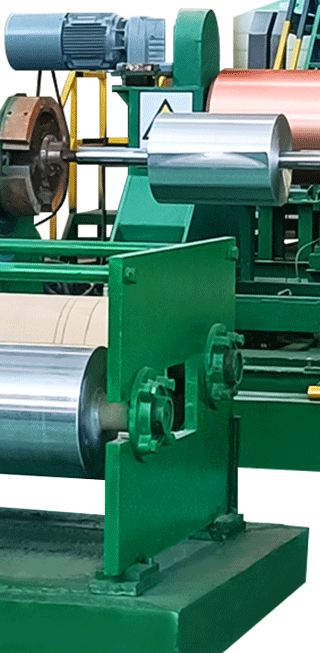
Aluminum food container foil is one of the most widely used materials in the food packaging industry. It works well for airline catering, fast food service, and everyday home cooking. The material is thin, light, and easy to shape. It also keeps food fresh, clean, and safe during transport or storage.
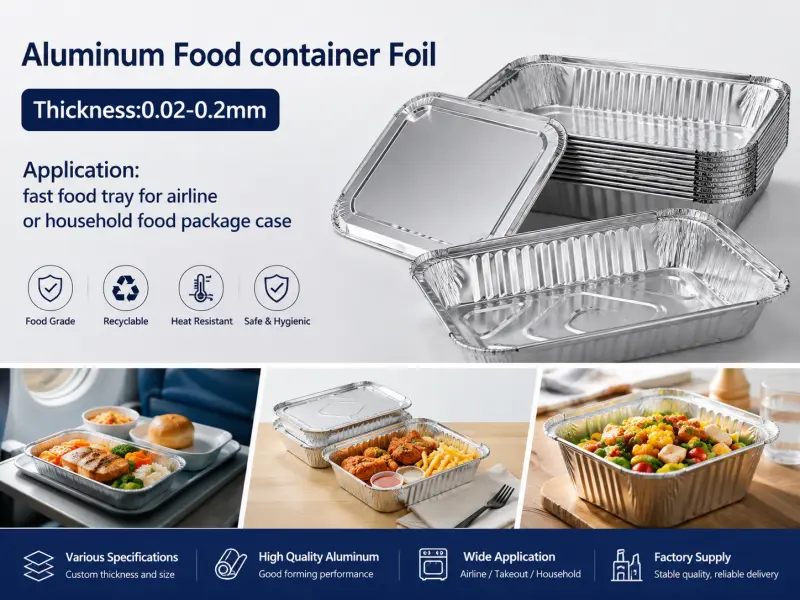
What Is Aluminum Food Container Foil?
Aluminum food container foil is a thin sheet of aluminum used to make food trays, lids, wrapping sheets, and packaging cases. It is produced by rolling aluminum ingots into very thin gauges — typically between 0.02mm and 0.2mm.
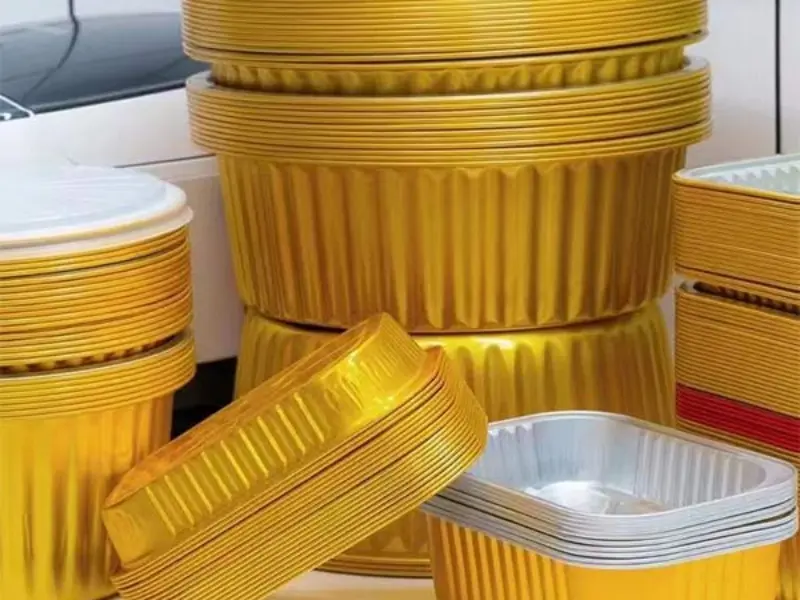
The foil is food-safe, recyclable, and heat-resistant. It can go directly from freezer to oven, which makes it a top choice for both commercial and home use.
Key Product Specifications
| Parameter | Details |
|---|---|
| Thickness Range | 0.02mm – 0.2mm |
| Width Range | 100mm – 1600mm |
| Inner Diameter | 76mm / 152mm (customizable) |
| Temper | O, H22, H24 |
| Alloy | 1xxx, 3xxx, 8xxx series |
| Surface | Mill finish, one-side bright |
| Standard | ASTM B479, EN 546, GB/T 3198 |
| MOQ | 1 – 5 tons (by alloy and size) |
| Coil Weight | Up to 3,000 kg per coil |
Alloy Types — Which One Fits Your Needs?
Different alloy grades offer different strength levels, formability, and corrosion resistance. Here is a breakdown of the most common choices.
1000 Series Aluminum Food Container Foil— Pure Aluminum
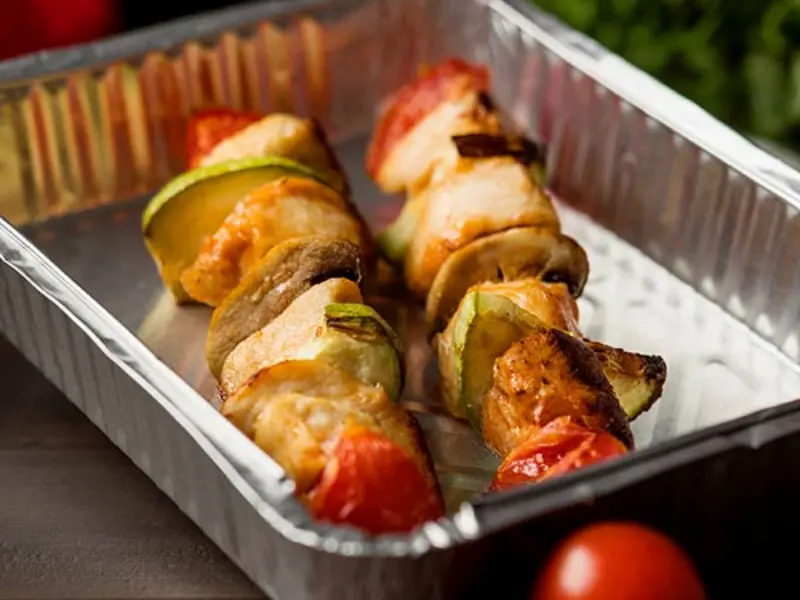
The 1000 series contains at least 99% aluminum. It is the softest and most ductile option available.
Best for: Light-duty household wrapping, butter wrapping, chocolate packaging
Common grades: 1050, 1060, 1070, 1100
Temper: O (fully annealed)
Thickness range: 0.02mm – 0.10mm
| Grade | Al Content | Tensile Strength | Key Feature |
|---|---|---|---|
| 1050 | ≥99.5% | 60–100 MPa | Very soft, easy to fold |
| 1060 | ≥99.6% | 55–95 MPa | Excellent corrosion resistance |
| 1100 | ≥99.0% | 75–115 MPa | Good formability |
3000 Series Aluminum Food Container Foil— Manganese Alloy
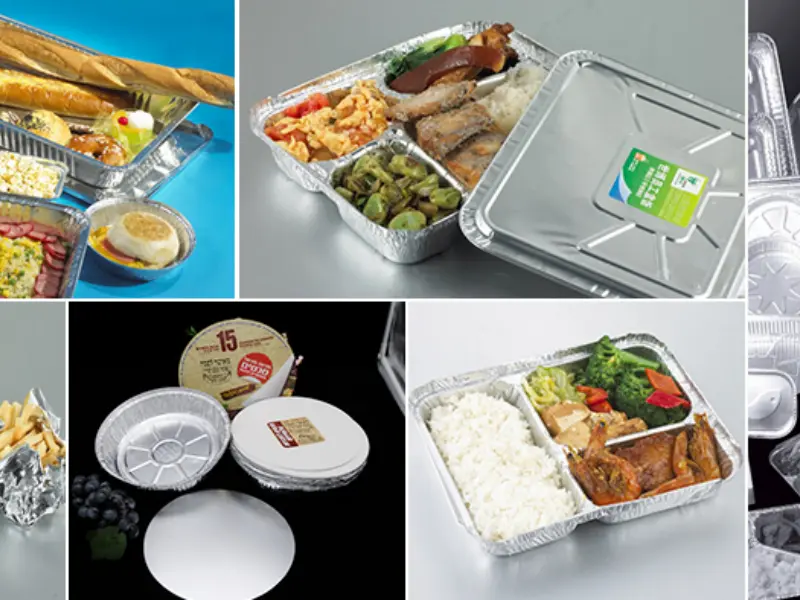
Adding manganese increases strength without losing flexibility. The 3000 series is the most popular choice for pressed food containers.
Best for: Airline meal trays, bakery pans, BBQ trays, takeaway containers
Common grades: 3003, 3004, 3105
Temper: O, H22, H24
Thickness range: 0.05mm – 0.20mm
| Grade | Main Alloy | Tensile Strength | Key Feature |
|---|---|---|---|
| 3003 | Al + Mn | 95–145 MPa | Best deep-draw performance |
| 3004 | Al + Mn + Mg | 145–215 MPa | Higher strength, good formability |
| 3105 | Al + Mn | 115–165 MPa | Good for lightweight trays |
8000 Series Aluminum Food Container Foil— Iron & Silicon Alloy
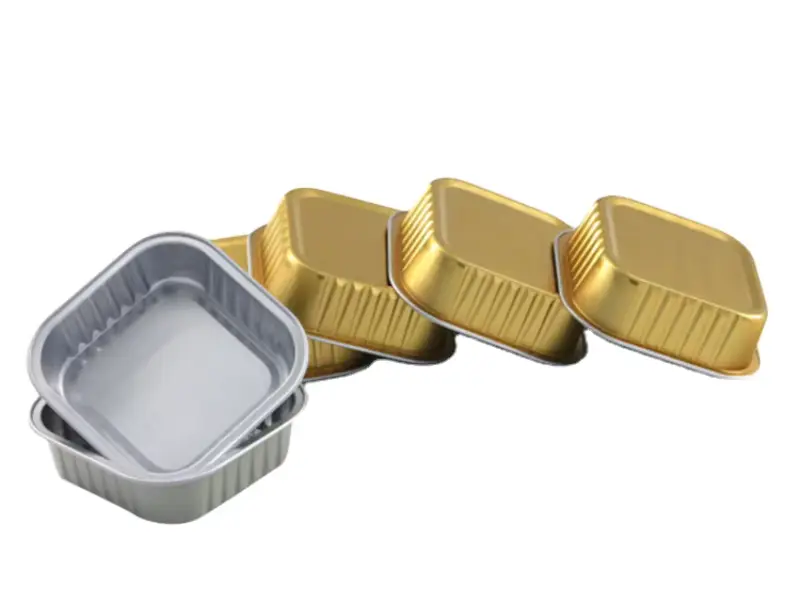
The 8000 series is designed specifically for thin-gauge foil rolling. It achieves the thinnest gauges with a smooth, bright surface.
Best for: Wrapping foil, lidding foil, pharmaceutical packaging, single-use containers
Common grades: 8006, 8011, 8021, 8079
Temper: O, H22
Thickness range: 0.02mm – 0.09mm
| Grade | Main Alloy | Tensile Strength | Key Feature |
|---|---|---|---|
| 8006 | Al + Fe + Si | 100–140 MPa | Pinhole-free, ideal for wrapping |
| 8011 | Al + Fe + Si | 90–130 MPa | Most common foil alloy |
| 8021 | Al + Fe | 85–125 MPa | Flexible, easy to laminate |
| 8079 | Al + Fe + Si | 90–130 MPa | Excellent barrier properties |
Temper Comparison — O vs H22 vs H24
Temper describes how hard or soft the foil is after processing.
| Temper | Condition | Hardness | Best Application |
|---|---|---|---|
| O | Full anneal | Softest | Wrapping, lidding, household use |
| H22 | Strain-hardened + partial anneal | Medium | Airline trays, bakery containers |
| H24 | Strain-hardened + partial anneal | Harder | Deep-draw trays, BBQ pans |
Simple rule:
- Use O temper when you need the foil to fold or wrap easily.
- Use H22 when you need a container to hold its shape.
- Use H24 when the tray needs to carry heavier food or withstand higher heat.
Thickness Guide — 0.02mm to 0.2mm
Thickness is one of the most important factors when selecting aluminum food container foil. Thinner foil is lighter and cheaper. Thicker foil is stronger and more rigid.
| Thickness (mm) | Gauge (approx.) | Weight (g/m²) | Typical Use |
|---|---|---|---|
| 0.02 – 0.03 | Ultra-thin | 54 – 81 | Chocolate wrapping, candy packaging |
| 0.03 – 0.05 | Thin | 81 – 135 | Household wrapping foil, butter packs |
| 0.05 – 0.08 | Light | 135 – 216 | Lidding foil, single-use trays |
| 0.08 – 0.12 | Standard | 216 – 324 | Airline meal trays, fast food boxes |
| 0.12 – 0.20 | Heavy | 324 – 540 | Roasting pans, heavy BBQ trays |
Product Types — From Rolls to Ready-Made Containers
Foil Rolls (Plain)
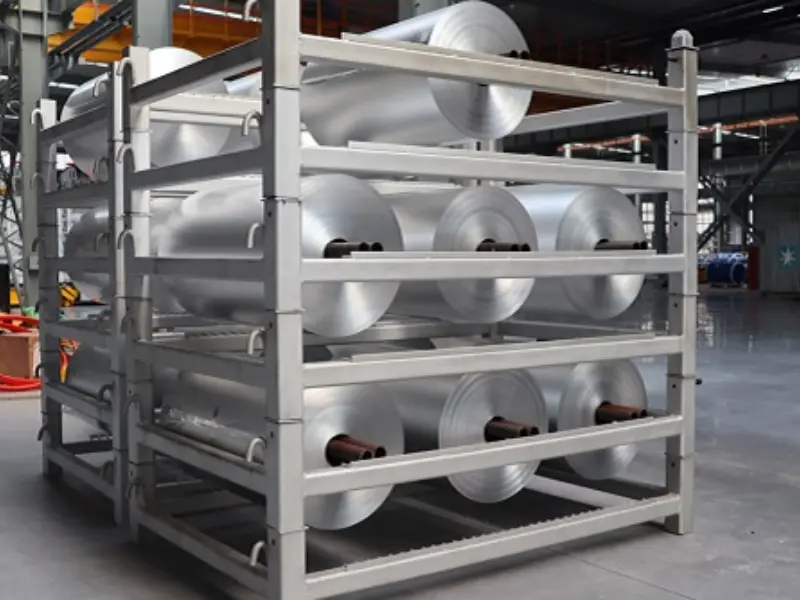
Foil rolls are the base product. They come in large coils and are used by manufacturers to press or stamp into containers.
- Width: 100mm – 1600mm
- Inner core: 76mm or 152mm
- Weight per coil: up to 3,000 kg
- Surface: mill finish or one-side bright
Container Foil Blanks (Disc / Sheet Cut)
Pre-cut blanks are flat pieces of foil cut to specific shapes. They are ready for pressing in automated lines.
- Custom shapes available: round, rectangular, oval
- Thickness: 0.05mm – 0.15mm
- Edge treatment: smooth cut, no burr
Pressed Aluminum Food Trays
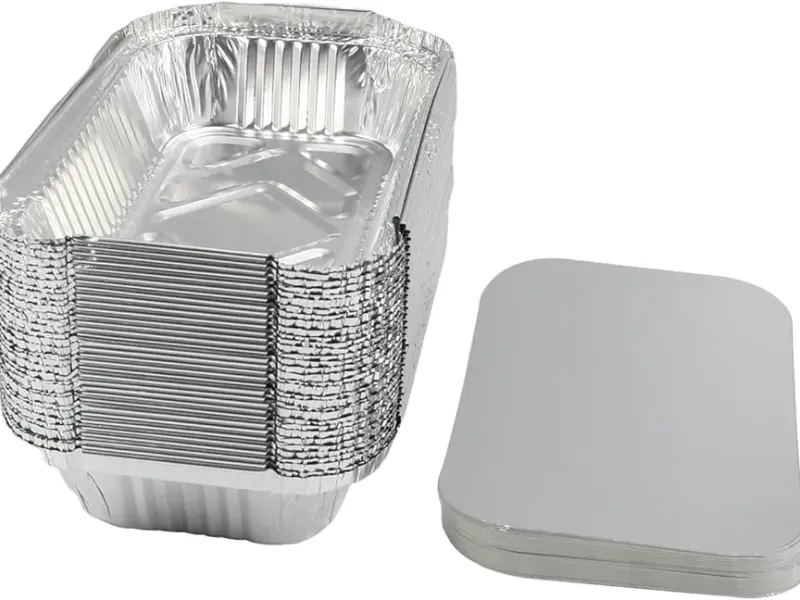
Pressed trays are finished containers, ready for food filling. These are the most common form used in airline catering and fast food service.
| Tray Type | Size Range | Thickness | Use |
|---|---|---|---|
| Single-portion tray | 150×120mm – 250×180mm | 0.07 – 0.12mm | Airline meals, ready-to-eat food |
| Multi-compartment tray | Up to 350×260mm | 0.08 – 0.15mm | Set meals, school lunch boxes |
| Oval roasting tray | 180×130mm – 400×280mm | 0.10 – 0.20mm | BBQ, oven roasting |
| Round container | Diameter 80mm – 250mm | 0.07 – 0.12mm | Cake molds, pie pans |
| Rectangular loaf pan | 180×85mm – 280×110mm | 0.09 – 0.15mm | Bread, terrine, pâté |
| Wrinkle wall container | Various | 0.06 – 0.10mm | Takeaway food, street food |
Lidding Foil
Lidding foil is a thinner, heat-sealable foil used as a cover for containers.
- Thickness: 0.02mm – 0.05mm
- With or without lacquer coating
- Can be printed for branding
Laminated Foil
Laminated foil combines aluminum with paper or plastic film.
- Foil + PE: moisture barrier, flexible pack
- Foil + PET: strong, printable, good heat resistance
- Foil + Paper: rigid, traditional look
Surface Finish Options
| Finish | Description | Best For |
|---|---|---|
| Mill finish | Natural aluminum look, no coating | Standard trays, wrapping |
| One-side bright | One surface polished | Premium food trays, display use |
| Lacquered | Food-safe lacquer coating | Acidic foods, long-term storage |
| Anodized | Oxidized surface, decorative | Bakeware, reusable containers |
| Printed | Custom logo or text | Branded airline trays, retail packs |
Application Areas
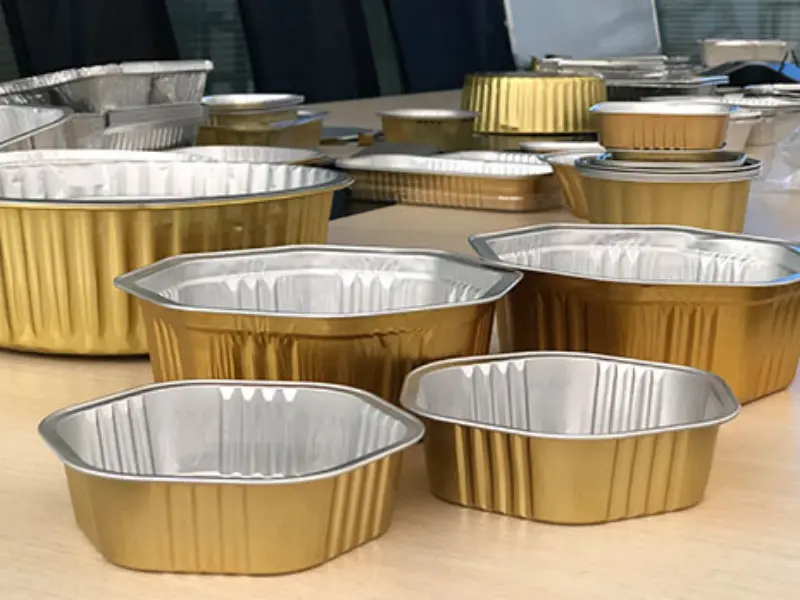
Aluminum food container foil is used across many industries. Here are the main sectors where this product performs best.
✈️ Airline Catering
- Single-use meal trays for business and economy class
- Multi-compartment trays for full meal sets
- Lidded containers to keep food sealed during flight
- Lightweight design reduces aircraft load
🏠 Household Use
- Oven roasting trays and baking pans
- Wrapping leftovers for fridge or freezer storage
- BBQ grilling trays for outdoor cooking
- Cake and muffin molds for home baking
🍔 Fast Food & Takeaway
- Burger and sandwich wrapping
- French fry trays and boxes
- Takeaway curry or rice containers
- Street food packaging for heat retention
🏥 Food Processing & Catering
- Ready-meal packaging for supermarkets
- Institutional catering for hospitals and schools
- Portion-control meal trays
- Frozen food packaging for retail
🎂 Bakery & Confectionery
- Loaf pans and bread tins
- Cake molds and pie pans
- Chocolate and candy wrapping
- Pastry packaging
🧪 Pharmaceutical & Specialty
- Blister pack base foil
- Sterile food-contact packaging
- Specialty diet meal packaging
Alloy & Thickness Comparison Table
This table helps you quickly match your product needs to the right specification.
| Application | Recommended Alloy | Temper | Thickness |
|---|---|---|---|
| Airline meal tray | 3003 / 3004 | H22 | 0.08 – 0.12mm |
| Household wrap | 8011 / 1235 | O | 0.02 – 0.05mm |
| BBQ tray | 3003 / 3105 | H24 | 0.12 – 0.20mm |
| Lidding foil | 8021 / 8079 | O | 0.02 – 0.04mm |
| Bakery pan | 3003 / 3004 | H22 | 0.09 – 0.15mm |
| Takeaway container | 3003 / 8011 | H22 | 0.07 – 0.10mm |
| Frozen food tray | 3004 / 3105 | H24 | 0.10 – 0.15mm |
| Candy/chocolate wrap | 8006 / 8011 | O | 0.02 – 0.04mm |
Why Choose Aluminum Over Plastic or Paper?
Many buyers compare aluminum food container foil with other packaging materials. Here is a direct comparison.
| Feature | Aluminum Foil | Plastic Container | Paper Box |
|---|---|---|---|
| Heat resistance | Up to 600°C | Up to 120°C (varies) | Low |
| Recyclability | 100% recyclable | Limited | Yes |
| Barrier properties | Excellent (light, air, moisture) | Moderate | Poor |
| Weight | Very light | Light | Light |
| Oven safe | Yes | No (most types) | No |
| Microwave safe | No | Yes (some) | Yes (some) |
| Freezer safe | Yes | Yes | Limited |
| Cost | Low–medium | Low | Low |
| Customizable | Yes | Yes | Yes |
Aluminum foil is the best choice when oven use, food safety, and barrier performance are the priority. Plastic wins for microwave heating. Paper works for dry or cold food packaging.
Frequently Asked Questions
About the Product
What alloy is best for airline food trays?
Alloy 3003 in H22 temper is the most common choice. It offers good deep-draw formability and enough strength to hold a meal tray shape without cracking. Thickness is usually between 0.08mm and 0.12mm.
What is the difference between 8011 and 3003?
8011 is in the 8000 series. It is iron-silicon based and best for thin foil rolling (under 0.10mm). It is often used for wrapping foil and lidding.
3003 is a manganese alloy. It is stronger and better for forming rigid containers. It handles deeper draws without tearing.
Can aluminum food container foil go in the oven?
Yes. Aluminum foil handles temperatures up to about 600°C. It is safe for standard ovens, convection ovens, and grills. It should not be used in a microwave oven.
Is the foil food-safe?
Yes, all food-grade aluminum foil meets international food safety standards including FDA 21 CFR, EU Regulation 10/2011, and GB 11333 (China). Lacquered versions use food-approved coatings.
About Specifications
What thickness do I need for a standard takeaway container?
For most takeaway food containers, 0.07mm to 0.10mm works well. This range gives enough rigidity to hold food while keeping the container light and affordable.
Can I get custom sizes?
Yes. Width, thickness, coil ID, and coil weight can all be customized. Pressed tray shapes and sizes can also be made to your drawing or sample.
What is the minimum order quantity?
MOQ depends on the alloy and form. Foil rolls typically start at 1–3 tons. Pressed trays can often start at 50,000 – 100,000 pieces per size.
About Shipping & Compliance
What certifications does the product carry?
Most suppliers offer foil that complies with:
- ISO 9001 (quality management)
- FSSC 22000 / BRC (food safety)
- FDA (USA market)
- EU food contact regulations
- SGS / Intertek test reports on request
How is the foil packaged for shipping?
Foil rolls are wrapped in waterproof kraft paper and packed in wooden pallets. Each coil is protected with a steel or plastic ring. For pressed trays, inner cardboard boxes and outer cartons are standard.
Can aluminum foil containers be recycled?
Yes. Aluminum is one of the most recyclable materials in the world. Used containers can be melted and reused without losing material quality. Clean foil recycling rates are over 70% in many countries.
About Pricing
What affects the price of aluminum food container foil?
Several factors drive cost:
- Alloy grade — 3000 series is slightly more expensive than 1000 series
- Thickness — thinner foil uses less material but needs more rolling passes
- Temper — O temper is cheaper; H24 involves more processing
- Order volume — larger orders reduce unit cost significantly
- Surface treatment — plain mill finish costs less than lacquered or printed
Is a price list available?
Prices change with the London Metal Exchange (LME) aluminum price. Contact your supplier for a current quote based on your alloy, thickness, and monthly volume.
Lightweight, food-safe, and customizable Aluminum Foil
Aluminum food container foil covers a wide range of applications — from ultra-thin wrapping at 0.02mm to heavy-duty roasting trays at 0.20mm. The right choice depends on:
- The alloy (1xxx for soft wrap, 3xxx for rigid trays, 8xxx for thin-gauge foil)
- The temper (O for flexibility, H22/H24 for strength)
- The thickness (matched to your container depth and food weight)
- The surface treatment (plain, lacquered, or printed)
Whether you need foil rolls for your production line, blank sheets for stamping, or finished pressed trays for airline catering — there is a specification that fits your exact requirement.
For samples, pricing, or technical data sheets, contact our sales team with your target thickness, alloy, and monthly volume.
SEO TDK
| Content | |
|---|---|
| Title Tag | Aluminum Food Container Foil 0.02–0.2mm |
| Meta Description | Shop aluminum food container foil in 0.02–0.2mm thickness. Available in 3003, 8011, and more alloys. Ideal for airline meal trays, takeaway boxes, BBQ trays, and household use. Food-safe and recyclable. |
| Keywords | aluminum food container foil, aluminum foil food tray, airline catering foil, household aluminum foil, 3003 aluminum foil, food grade aluminum foil thickness, takeaway container foil, bbq aluminum tray, pressed aluminum tray, 8011 aluminum foil |